
The University of Vienna is a research university enjoying high international visibility. Its profile reflects the characteristics of the area it is located in, and understands research as a global challenge. In October 2022 the University of Vienna congratulated Nobel Prize winner Anton Zeilinger.
including 15 faculties and 5 centres representing the University's academic units
to promote especially innovative interdisciplinary research projects
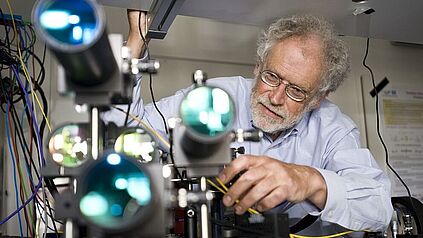
Anton Zeilinger's experiments with entangled photons provide new insights into the foundations of quantum physics and prepare the ground for new technologies based on quantum information.

The University of Vienna was founded by Duke Rudolph IV in 1365. Today, 7,600 researchers conduct basic and applied research at the 15 faculties and 5 centres of the University of Vienna, thus tackling present and future challenges.

The vast array of disciplinary and interdisciplinary research at the University of Vienna includes theology, law, business, economics and statistics, computer science, historical and philological studies, social sciences, psychology, life sciences, natural sciences, mathematics, sport science and teacher education.

The University of Vienna's vision is to become one of the leading research universities in Europe. In 2023 the University of Vienna raised funding revenues of EUR 117,6 million. At the University of Vienna 149 ERC grant holders are conducting research.
ERC Grants at the University of Vienna

The University of Vienna supports their researchers' mobility and is an attractive destination for international researchers. And each semester the University of Vienna welcomes numerous guest scientists.

With its 7,600 academics, more than 500 of whom are professors, the University of Vienna is the largest research and educational institution in Austria.The principle of research-led teaching is embedded in the curriculum of all degree programmes by our teaching staff that impart knowledge about latest research findings in their courses.

Creative junior researchers are crucial for the development of research at the University of Vienna. They stimulate academic innovation. The University takes appropriate measures to support early stage researchers and the career progression of women.

With its Main Building on Universitätsring and the University’s Campus in Vienna’s ninth district, the University of Vienna is fortunate to be right in the city centre. This location facilitates exchange between researchers, teaching staff and Vienna’s population. Additionally, the University of Vienna has 70 locations that shape Vienna’s cityscape.